






Estudios científicos
Lipid Profiles After Changes in Alcohol Consumption Among Adults Undergoing Annual Checkups
Abstract:
Importance Despite growing criticism of alcohol consumption due to its overall health risks, it remains unknown how changes in alcohol consumption, particularly cessation, affect lipid profiles outside of intense interventions.
Objective To clarify the association of alcohol initiation and cessation with subsequent changes in low-density lipoprotein cholesterol (LDL-C) and high-density lipoprotein cholesterol (HDL-C).
Design, Setting, and Participants This cohort study included individuals undergoing annual checkups at a center for preventive medicine in Tokyo, Japan, from October 2012 to October 2022. Individuals treated with lipid-lowering medications were excluded. Data were analyzed from May to December 2024.
Exposures Alcohol initiation (vs remaining abstainer) and cessation (vs continuing same alcohol intake) between 2 consecutive visits. One standard drink was equivalent to 10 g of pure ethanol.
Main Outcomes and Measures Change in LDL-C and HDL-C levels between 2 consecutive visits.
Results Among the 328 676 visits from 57 691 individuals (mean [SD] age, 46.8 [12.5] years; 30 576 female [53.0%]), the cohort for evaluating alcohol cessation comprised 49 898 visits among 25 144 participants (mean [SD] age, 49 [12.1] years; 12 334 female [49.1%]; mean [SD] LDL-C, 114.7 [28.4] mg/dL; mean [SD] HDL-C, 65.5 [16.4] mg/dL). Alcohol cessation was associated with changes in LDL-C of 1.10 mg/dL (95% CI, 0.76 to 1.45 mg/dL) among those discontinuing habits of fewer than 1.5 drinks/d, 3.71 mg/dL (95% CI, 2.71 to 4.71 mg/dL) for 1.5 to 3.0 drinks/d, and 6.53 mg/dL (95% CI, 5.14 to 7.91 mg/dL) for 3.0 or more drinks/d. Cessation was associated with a change in HDL-C of −1.25 mg/dL (95% CI, −1.41 to −1.09 mg/dL) among those discontinuing habits of fewer than 1.5 drinks/d, −3.35 mg/dL (−4.41 to −2.29 mg/dL) for 1.5 to 3.0 drinks/d, and −5.65 mg/dL (95% CI, −6.28 to −5.01 mg/dL) for 3.0 or more drinks/d. The cohort for evaluating alcohol initiation (107 880 visits; 29 042 participants) showed inverse dose-response associations.
Conclusions and Relevance In this cohort study of Japanese annual health checkup participants, alcohol initiation was associated with modest cholesterol improvement, whereas cessation was associated with less favorable changes. After alcohol reduction, lipid profile changes should be carefully monitored to optimize cardiovascular disease risk management at both individual and population levels.
Comentarios divulgativos:
El objetivo de esta investigación observacional fue evaluar la relación entre los cambios en el consumo de bebidas y la evolución del perfil de lípidos sanguíneos a largo plazo. Los resultados encontraron una asociación entre el inicio del consumo y una mejora moderada del perfil lipídico, mientras que cesar su consumo se asociaba con cambios menos favorables.
En este estudio observacional de cohortes participaron 57.691 japoneses (edad media 46,8 años; 53% mujeres) con datos que se recogieron durante chequeos anuales de salud, a los que se realizó un seguimiento durante dos visitas consecutivas.
Tanto iniciar como cesar el consumo se asociaba con cambios en los niveles de colesterol LDL y HDL de manera dependiente de la dosis. Los cambios hacia un consumo ligero se asociaban con resultados potencialmente favorables: disminución del colesterol LDL y un aumento de los niveles de HDL. Por el contrario, el abandono mostró una asociación opuesta.
Los autores enfatizan la importancia del consumo moderado y sugieren que, para optimizar la gestión del riesgo de enfermedad cardiovascular, después de la reducción en el consumo los cambios en el perfil lipídico deberían controlarse.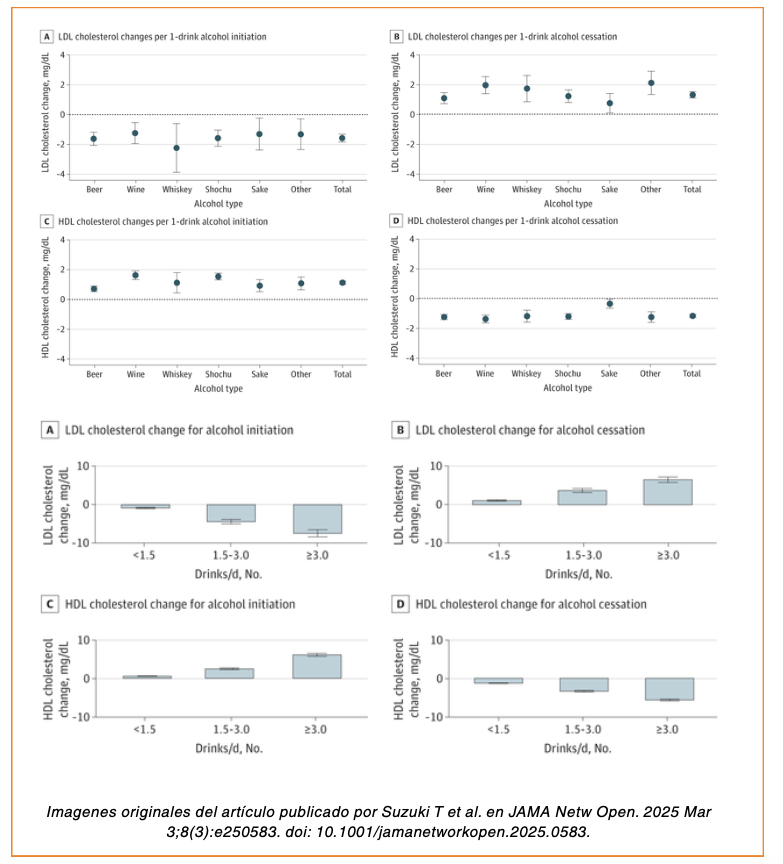
Imagenes originales del artículo publicado por Suzuki T et al. en JAMA Netw Open. 2025 Mar 3;8(3):e250583. doi: 10.1001/jamanetworkopen.2025.0583.