





Estudios científicos
Alcohol-attributable cancer risk and burden estimates for Australia’s updated alcohol consumption guidelines
Abstract:
Acknowledgements
The authors wish to acknowledge and thank the late Professor Dame Valerie Beral AC FRS for her contributions to the methods of the study and the interpretation of the results, including for this article and our previous articles investigating alcohol use and cancer risk and alcohol use and cause-specific mortality. This research was completed using data collected through the 45 and Up Study (www.saxinstitute.org.au). The 45 and Up Study is managed by the Sax Institute in collaboration with major partner Cancer Council NSW and partners the Heart Foundation and the NSW Ministry of Health. We thank the many thousands of people participating in the 45 and Up Study. We thank the NSW Ministry of Health and Cancer Institute NSW for the use of their data.
Funding
The authors received no specific funding for this work. PS was funded by a postgraduate research scholarship from Cancer Council NSW, the 45 and Up PhD Scholarship in Cancer Research. KC is co-principal investigator of an unrelated investigator-initiated trial of cervical screening in Australia (Compass; ACTRN12613001207707 and NCT02328872), which is conducted and funded by the VCS Foundation (VCS), a government-funded health promotion charity. KC is also an investigator of Compass New Zealand (ACTRN12614000714684), which was conducted and funded by Diagnostic Medlab (DML), now Auckland District Health Board. The VCS Foundation received equipment and a funding contribution from Roche Molecular Systems and Ventana USA and DML received equipment and a funding contribution for Compass from Roche Molecular Systems. However, neither KC nor her institution on her behalf receives direct funding from industry for this trial or any other project. EB and KC are supported by Investigator Grants from the National Health and Medical Research Council of Australia (NHMRC) (references 1136128 and 1194679, respectively). EB was Deputy Chair of the NHMRC Alcohol Working Group (2016-2020) which advised on the updated national Australian guidelines on alcohol consumption. NH is supported by a National Breast Cancer Foundation Chair in Breast Cancer Prevention grant (reference: EC-21-001) and an NHMRC Investigator Grant (reference: 1194410). The other authors have no funding to declare. Funding sources did not have any role in study design; in the collection, analysis and interpretation of data; in the writing of the report; and in the decision to submit the article for publication. Open Access funding enabled and organized by CAUL and its Member Institutions.
Comentarios divulgativos:
Antecedentes: Las directrices de salud sobre el alcohol de Australia de 2020 recomendaron un máximo de 10 bebidas por semana. Este estudio analiza el impacto de la aparición de cáncer atribuible al alcohol en Australia para consumos dentro de estos límites.
Métodos: Se analizó el riesgo (HR) de la incidencia de cáncer en relación con el consumo de alcohol autoinformado (bebidas/semana) entre 225.805 participantes de 45 años o más (2005–2009) en el Estudio «45 and Up» de Nueva Gales del Sur (NSW). El riesgo absoluto acumulado de cáncer hasta los 85 años se estimó utilizando de 0 a <1 bebida/semana como comparador.
Resultados: Durante una mediana de 11.4 años, se registraron 34.860 casos de cáncer. Al modelarse como una variable continua, el riesgo de cáncer relacionado con el alcohol aumentó en un 19% por cada incremento de diez bebidas por semana (HR: 1.19; intervalo de confianza del 95%: 1.15–1.23). Para la edad de 85 años, el riesgo aumentaba un 4.9% con un consumo moderado respecto a un consumo de 0 a <1 bebida por semana. Se estimó que 7.804 casos de cáncer (el 4.6% de todos los casos de cáncer) fueron atribuibles al consumo de alcohol en 2024.
Conclusiones: La proporción de cánceres atribuibles al alcohol en Australia es sustancial y algo mayor de lo estimado previamente.
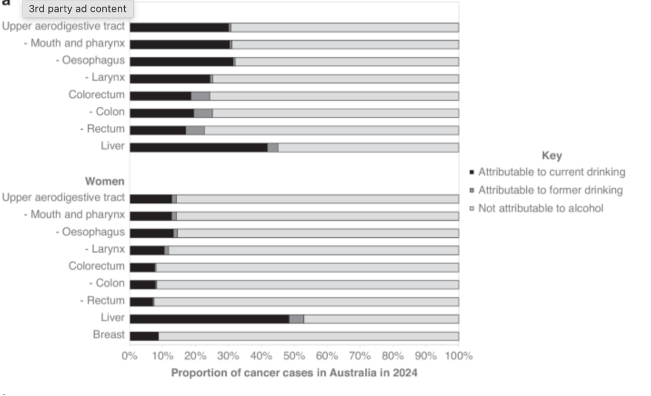
Comentario: Es un estudio epidemiológico de cohorte con las limitaciones propias de los estudios observacionales, pero con una población amplia y seguimiento prolongado. Los resultados reportan que el riesgo de cáncer aumenta de forma continua, hecho ya conocido, pero sin un umbral específico que indique ausencia de riesgo. Así, la mitad de los cánceres atribuibles al alcohol en Australia ocurrieron en personas que bebían moderadamente (10 bebidas o menos por semana). Este dato puede haber estado influido por el “underreporting” ya que es común que los individuos reporten que beben menos de lo que en realidad consumen. El incremento de riesgo se observó incluso con edades avanzadas, por un efecto acumulativo, sin apreciarse cambios según el consumo fuera regular o episódico, sugiriendo que el volumen total es el factor determinante. Aunque sea discutible a nivel epidemiológico la atribución del cáncer a un factor único como el alcohol, por existir factores de confusión (tabaco, dieta, estilo de vida, genética, etc.), los resultados de este estudio alertan de la relación de riesgo entre alcohol y cáncer, incluso con consumos considerados como moderados, por lo que pueden influir en las recomendaciones de salud.