





Estudios científicos
Association between high-risk drinking and cardiovascular health based on Life’s Essential 8: analysis using 2016–2021 Korean National Health and Nutrition Examination Survey data
Abstract:
Objectives Alcohol consumption above recommended limits has been associated with increased cardiovascular disease (CVD) risk in observational studies. In particular, little is known about the association between high-risk drinking and cardiovascular health (CVH), as assessed by the American Heart Association’s Life’s Essential 8 (LE8) health metrics, in the context of community-based population datasets. Therefore, this study aimed to determine the relationship between high-risk drinking and CVH status using data from the 2016–2021 Korea National Health and Nutrition Examination Survey (KNHANES).
Design Cross-sectional secondary analysis study.
Setting The 2016–2021 KNHANES.
Participants This analysis included 18 500 adults aged 19 years or older.
Primary and secondary outcome measures High-risk drinking was defined as consuming seven or more drinks (or five cans of beer) in one sitting for men, and five or more drinks (or three cans of beer) for women, at least once a month. The frequency of high-risk drinking was categorised as follows: ‘rarely or never’, ‘less than once per month’, ‘at least once per month’, ‘once a week’ or ‘nearly daily’. We calculated an LE8 score for each of eight composite metrics, with each metric ranging from 0 to 100. LE8 total scores were categorised as 0–49, 50–79 and 80–100, representing low, moderate and high CVH, respectively. We used weighted log-linear regression models to analyse the relationship between high-risk drinking and CVH.
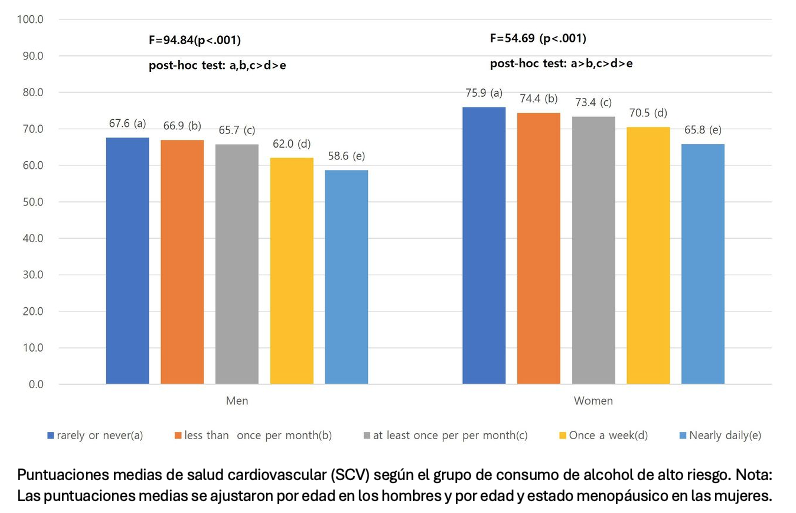
Results Nearly daily or weekly high-risk drinking was reported by 37.3% of men and 14.7% of women. The mean CVH score of groups with more frequent high-risk drinking decreased linearly in both sexes. Using the ‘nearly daily’ drinking group as the reference group, the exponential coefficients (exp(B)) showed that the total CVH score increased progressively as the frequency of high-risk drinking decreased in both men and women. Compared with the ‘nearly daily’ group, the total CVH score was 5% higher in the ‘once a week’ group (exp(B)=1.05, p<0.001) and 14% higher in the ‘rarely or never’ group (exp(B)=1.14, p<0.001) for men. Similar trends were observed for female participants (once a week: exp(B)=1.04, p<0.001; rarely or never: exp(B)=1.13, p<0.001).
Conclusions This study found that high-risk drinking was negatively associated with ideal CVH in Korean adults, and this association showed sex differences. Interventions targeting high-risk drinking may be more effective than focusing on overall alcohol consumption.
Comentarios divulgativos:
Objetivos: Determinar la relación entre el consumo de alto riesgo y el estado de la salud cardiovascular (SCV), evaluada mediante el Life’s Essential 8 (LE8) de la Asociación Americana del Corazón (AHA) que evalúa 4 hábitos de vida (dieta, actividad física, tabaco, y sueño) y 4 factores de riesgo cardiovascular (índice de masa corporal, glucemia, colesterol y tensión arterial), utilizando datos de la Encuesta Nacional de Examen de Salud y Nutrición de Corea (KNHANES) de 2016-2021.
Diseño: Estudio retrospectivo transversal con 18.500 adultos de 19 años o más.
Resultados: El 37.3% de los hombres y el 14.7% de las mujeres informaron un consumo de alto riesgo casi a diario o semanal. En comparación con el grupo de consumo de alto riesgo «casi diario», la puntuación total de SCV fue un 5% mayor en el grupo de «una vez a la semana» (exp(B)=1.05, p<0.001), es decir mayor SCV, y un 14% mayor en el grupo de «rara vez o nunca» (exp(B)=1.14, p<0.001) para los hombres. Se observaron tendencias similares para las mujeres. Los factores conductuales (dieta, tabaco y sueño) se vieron más afectados por la frecuencia del consumo de alto riesgo que los factores biológicos como los lípidos o la glucosa en sangre.
Conclusiones: El patrón de consumo de alcohol de alto riesgo (tipo atracón) se asoció con una menor SCV. Las intervenciones dirigidas a reducir el consumo de alto riesgo podrían ser tan eficaces como centrarse en el consumo total de alcohol.
Comentario: Este estudio resalta que el consumo de alcohol en atracón es un factor añadido a los factores clásicos de riesgo cardiovascular (colesterol, glucemia, presión arterial, tabaco, peso, sedentarismo, dieta y alteración del sueño). Cabe destacar, no obstante, que el estudio no es extrapolable a España dado que la cultura de consumo de alcohol en Corea es muy distinta de la mediterránea, y se basa casi exclusivamente en el licor y en consumos episódicos elevados por motivos sociales.